
Overview
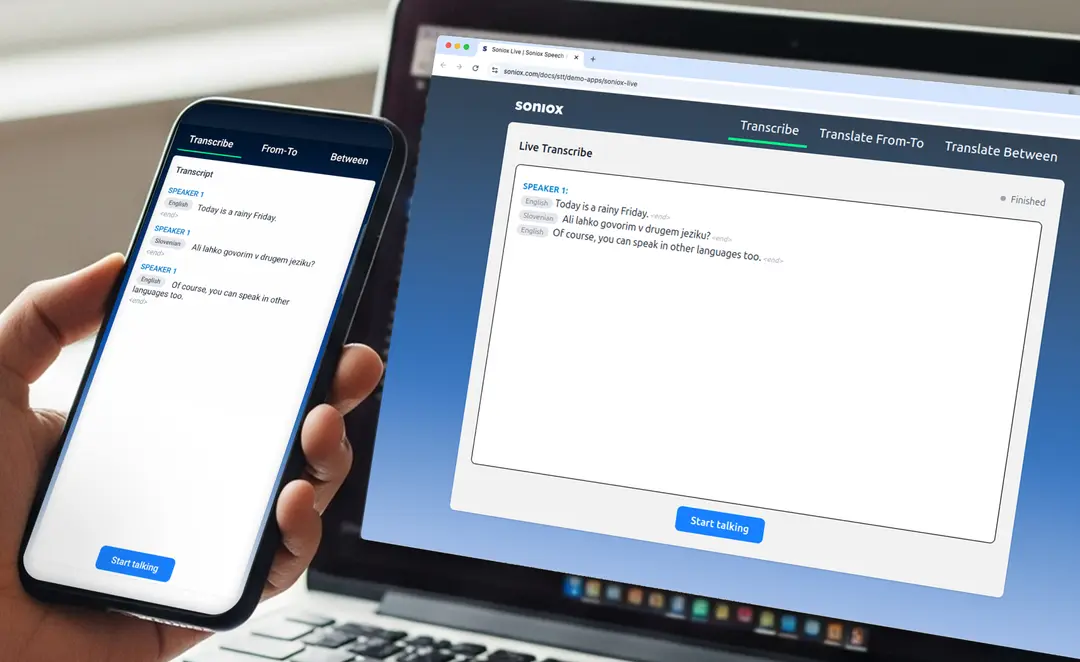
Soniox Speech-to-Text API runs on the next generation of high-accuracy voice AI models developed by Soniox.With Soniox Speech-to-Text API you can:- Recognize speech with native-speaker accuracy across 60+ languages- Handle language switching mid-sentence in real-time- Accurately capture alphanumerics like emails, addresses, and phone numbers- Detect when a speaker has finished speaking- Separate speakers in real time across 60+ languages- Boost accuracy with domain-specific context- Translate speech as people speak, not after they finish (3,600 language pairs supported)Soniox Speech-to-Text API is engineered for large-scale, low-latency, cost-efficient audio processing, delivering consistent performance under high concurrency and sustained workloads.Soniox platform is SOC 2 Type II certified, HIPAA compliant, and GDPR compliant, and supports regional deployments with data residency guarantees, ensuring customer audio and transcripts remain within the selected geographic region. This enables secure deployment in regulated and privacy-sensitive environments while maintaining predictable performance and optimized total cost of ownership.Soniox powers a wide range of real-time and high-volume speech applications, including medical and clinical transcription, voice agents and conversational AI, contact center analytics, wearables and edge devices, live captioning and accessibility, and multilingual collaboration tools. Its low-latency streaming, accurate speaker separation, and strong handling of domain-specific terminology make it well suited for mission-critical workflows where accuracy, responsiveness, and compliance are non-negotiable.
Pros and Cons
Pros
- High-accuracy transcription in over 60 languages
- Speaker recognition
- Language identification
- Endpoint detection
- Custom context support
- Instant multilingual translations
Cons
- Assumes ownership of the surrounding workflow
- Streaming features require understanding websockets
- Developer-centric by design
- No details about lightness for devices
- Not positioned as a no-code solution
Categories
- Primary: Creativity
- Secondary: Text
- Specialty: Transcription
Community Feedback
Only the latest comments are shown.Best STT on the market for both speed and accuracy. Developer friendly API makes integration effortless.
The best STT provider with excellent custom vocabulary integration. The speed is great, and it works perfectly with EUbased data. I highly recommend it.
This is the first speech AI I have found that works fore every language that my users need. My app can now process every European language flawlessly. Thanks team Soniox!