
Overview
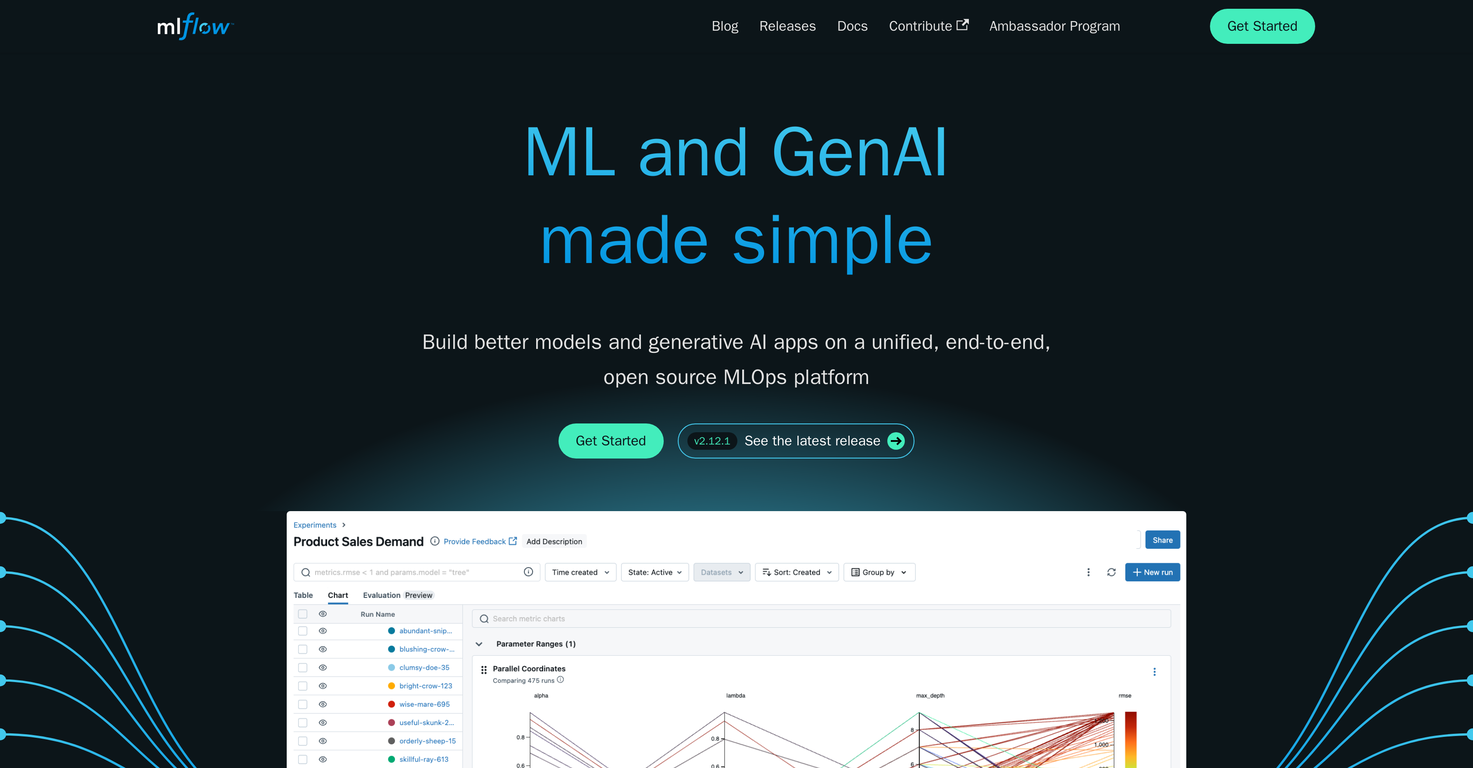
MLflow is an open source MLOps platform designed for building and managing better models and generative AI applications. The platform simplifies the running of machine learning and generative AI projects, allowing developers to take on complex, real-world challenges.MLflow has key features including experiment tracking, visualization, generative AI capabilities, model evaluation, and a model registry. Furthermore, it provides comprehensive capabilities for managing end-to-end machine learning and Generative AI workflows from development to production.The platform is unified, making it suitable for both traditional machine learning and generative AI applications. MLflow can streamline the entire machine learning and generative AI lifecycle.It allows users to improve generative AI quality, build applications with prompt engineering, track progress during fine tuning, package and deploy models, and securely host models at scale.It is extremely versatile and can be run on various platforms, including Databricks, cloud providers, data centers, and personal computers. MLflow is also integrated with numerous tools and platforms like PyTorch, HuggingFace, OpenAI, LangChain, Spark, Keras, TensorFlow, Prophet, scikit-learn, XGBoost, LightGBM, and CatBoost.
Pros and Cons
Pros
- Open source platform
- Experiment tracking feature
- Powerful visualization capabilities
- Model evaluation
- Model registry
- Manages end-to-end workflows
Cons
- Lack of customer support
- Complex Configuration
- No GUI
- No real-time collaboration
- Minimum workflow automation
- Limited algorithm support
Categories
- Primary: Creativity
- Secondary: Software
- Specialty: Apps
Community Feedback
Only the latest comments are shown.it's wild how MLflow takes chaotic experiments and turns them into neat, tweakable apps.it's open source, dead-simple to install and crazy fast at loggin metrics. kudos to the dev :D